Skip to content
-
Subscribe to our newsletter & never miss our best posts. Subscribe Now!
Cracking My Interview - Your Interview Partner Cracking My Interview - Your Interview Partner

Cracking My Interview - Your Interview Partner

Cracking My Interview - Your Interview Partner Cracking My Interview - Your Interview Partner

Cracking My Interview - Your Interview Partner

  • Java
  • Designs
  • Data Structure
  • Micro Services
  • Spring Boot
  • Machine Learning
  • Big Data
  • Basics
  • Computer Basics
  • Cyber Security
  • Java
  • Designs
  • Data Structure
  • Micro Services
  • Spring Boot
  • Machine Learning
  • Big Data
  • Basics
  • Computer Basics
  • Cyber Security
BasicsCyber Security

What is D-DOS attack ?

By SND
June 16, 2026 2 Min Read
0

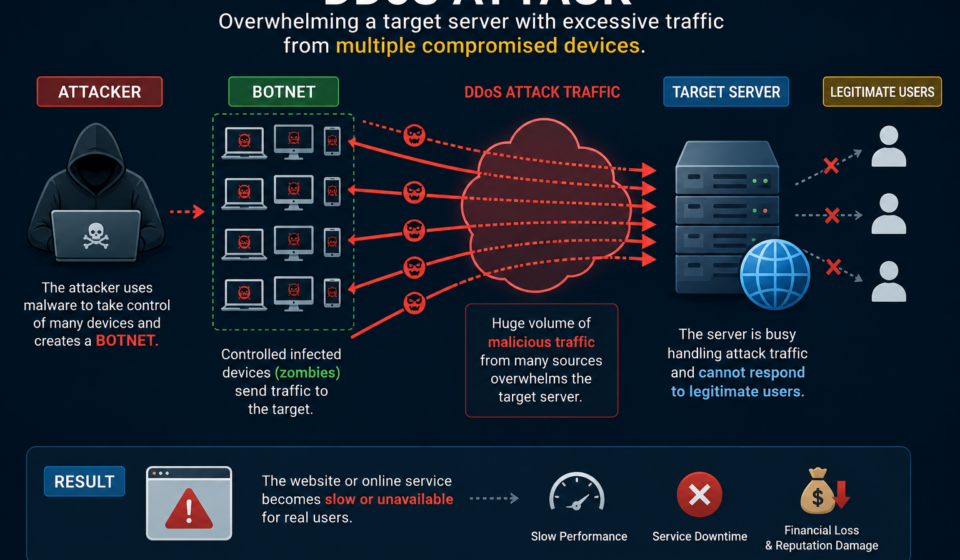
A DDoS attack stands for Distributed Denial of Service attack.

It is a cyberattack where an attacker uses many computers, servers, or internet-connected devices (often a “botnet” of compromised devices) to overwhelm a target system with traffic or requests, making it slow or completely unavailable to legitimate users.

How it works

Imagine a restaurant with 50 seats:

  • Normally, customers arrive at a manageable rate and get served.
  • During a DDoS attack, thousands of fake customers flood the restaurant at once.
  • Real customers can’t get a seat or receive service.

The same thing happens to websites, online games, APIs, or networks.

Common types of DDoS attacks

  1. Volume-based attacks
    • Flood the target with massive amounts of traffic.
    • Example: sending millions of requests per second.
  2. Protocol attacks
    • Exploit weaknesses in network protocols.
    • Example: SYN flood attacks.
  3. Application-layer attacks
    • Target specific services such as web pages or login systems.
    • Example: overwhelming a website’s search function with requests.

Effects of a DDoS attack

  • Website outages
  • Slow performance
  • Service interruptions
  • Lost revenue
  • Increased infrastructure costs

Why “Distributed”?

A regular DoS (Denial of Service) attack comes from a single source.

A DDoS attack comes from many sources simultaneously, often thousands or millions of devices spread across different locations, making it much harder to block.

How organizations defend against DDoS attacks

  • Traffic filtering and rate limiting
  • Content Delivery Networks (CDNs) such as Cloudflare
  • DDoS protection services from providers like AWS Shield and Google Cloud Armor
  • Load balancing
  • Web Application Firewalls (WAFs)

Simple example

If a website normally receives 10,000 visitors per hour, a DDoS attack might generate millions of fake requests per hour, consuming all available bandwidth and server resources so real users cannot access the site.

DDoS attacks are illegal in most countries and are often used for extortion, vandalism, political disruption, or as a distraction while other cyberattacks are carried out.


Author

SND

Technology leader with 24 years of experience designing and delivering large-scale enterprise applications across multiple industries. Expertise in Java, Spring ecosystem, cloud-native architectures, and distributed systems. Strong background in Big Data, machine learning, and building scalable, high-performance platforms. Extensive experience with open-source technologies, databases, microservices, and modern application modernization initiatives. Proven track record of leading architecture, engineering, and digital transformation programs from concept to production.

Follow Me
Other Articles
Previous

How to design a Recommendation System- use ML/Machine Learning Algorithms

Next

Hardware vs Software

No Comment! Be the first one.

Leave a Reply Cancel reply

Your email address will not be published. Required fields are marked *

Recent Posts

  • From Physical Servers to Kubernetes: The Complete Evolution of Application Networking (Explained with real example – TravelCity)
  • Retrieval-Augmented Generation (RAG): Architecture, Pipeline, and Enterprise Implementation
  • Building Enterprise AI Applications with RAG and LangChain
  • From ChatGPT to AI Agents to MCP: Understanding the Evolution of Enterprise AI
  • Service Discovery in Microservices: From Eureka to Kubernetes

Recent Comments

  1. Tom on Web Application Architecture in AWS (Amazon)
  2. A WordPress Commenter on DESIGN A LOG AGGREGATION SYSTEM

Archives

  • July 2026
  • June 2026

Categories

  • Basics
  • Computer Basics
  • Cyber Security
  • Data Structure
  • Designs
  • Java
  • Machine Learning
  • Micro Services
  • Spring Boot
  • AI ML LLM Agents
  • Java SpringBoot REST
  • Design Problems
  • Data Structure
Contact us

contact@crackingmyinterview.com

  • YouTube
  • Facebook
Copyright 2026 — Cracking My Interview - Your Interview Partner. All rights reserved. Blogsy WordPress Theme