
1. Requirements Gathering
Functional Requirements
We need a system that:
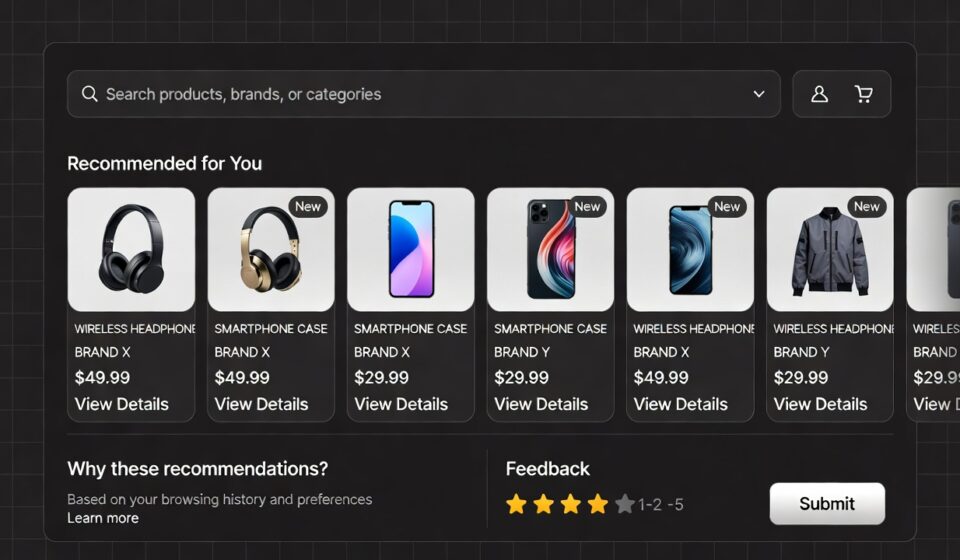
- Recommends personalized content/products
- Learns from user behavior
- Supports millions of users and items
- Handles new users and new items
- Updates recommendations based on recent activity
Non-Functional Requirements
| Requirement | Target |
|---|---|
| Relevance | High CTR/Conversion |
| Latency | <100ms |
| Availability | 99.9% |
| Freshness | Minutes or seconds |
| Scalability | Millions of users |
2. High-Level Approach
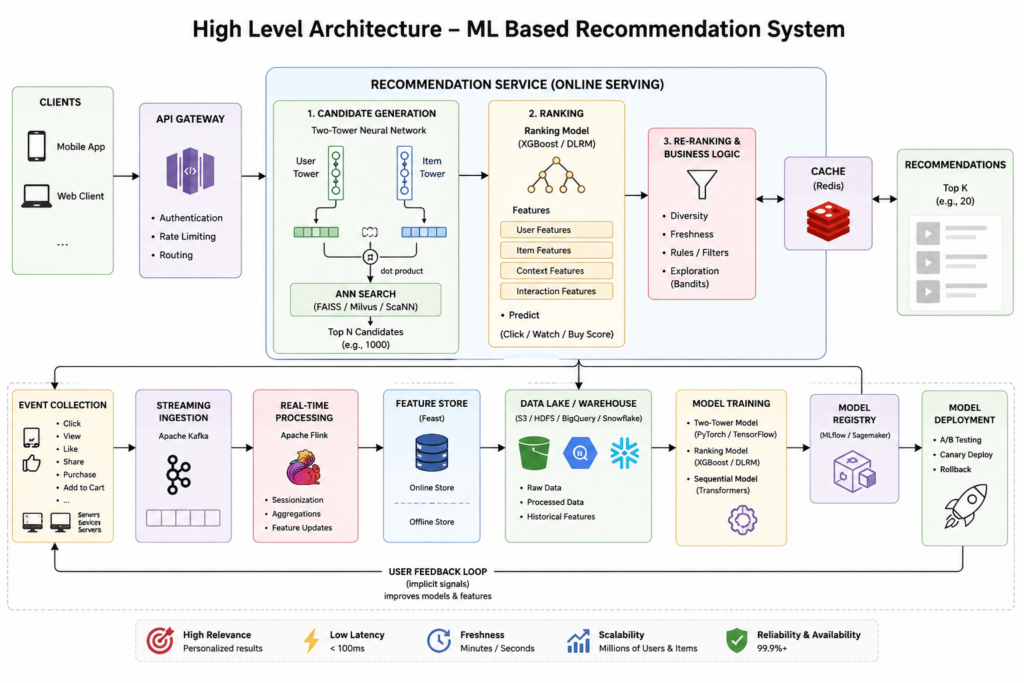
I would use a two-stage recommendation architecture:
Candidate Generation
        ↓
Candidate Ranking
        ↓
Recommendations
Reason:
If we have 100 million products/videos, we cannot rank all 100 million for every request.
Instead:
100M items
   ↓
1000 candidates
   ↓
Top 20 recommendations
This is the architecture used by companies like YouTube, Netflix, and Amazon.
3. Data Collection Layer
Before training any ML model, we need behavioral data.
User actions:
View
Click
Like
Watch Time
Purchase
Add To Cart
Share
Technology: Apache Kafka
Use:
- Apache Kafka
Why?
- High throughput
- Durable event storage
- Real-time streaming
- Industry standard for event ingestion
Architecture:
User
  ↓
Kafka Topics
Example:
{
  "userId": "123",
  "itemId": "456",
  "event": "click",
  "timestamp": "..."
}
4. Feature Engineering Layer
Raw events aren’t enough.
We need features like:
Last 7 day clicks
Favorite category
Average watch time
Purchase frequency
Technology: Apache Flink
Use:
- Apache Flink
Why?
Because requirements mention:
Freshness
We want recommendations to adapt within minutes.
Flink continuously computes:
User clicked 5 football videosand updates features immediately.
Pipeline:
Kafka
   ↓
Flink
   ↓
Feature Store
5. Feature Store
Store ML features centrally.
Technology: Feast
Use:
- Feast
Why?
Without a feature store:
Training Features
!=
Serving Features
This causes training-serving skew.
Feast ensures:
Same feature definitions
Same feature values
for both training and inference.
Examples:
user_avg_watch_time
user_category_affinity
item_ctr
item_popularity
6. Candidate Generation
Now the ML starts.
Requirement:
100 million itemscannot be ranked directly.
Need:
100 million
      ↓
1000 candidates
Algorithm Choice: Two-Tower Neural Network
Why not collaborative filtering?
Problems:
- Doesn’t scale well
- Cold-start issues
- Hard to include rich features
Modern industry uses:
Two-Tower RetrievalArchitecture:
User Features
      ↓
User Tower
      ↓
User Embedding
Item Features
↓
Item Tower
↓
Item EmbeddingTraining objective:
Bring relevant user-item pairs closer in vector space.
Technology: PyTorch
Use:
- PyTorch
Why?
- Industry standard
- Flexible
- Excellent for deep learning
Alternative:
- TensorFlow
7. Vector Search
After training:
Each item becomes:
128-dimensional vectorNeed nearest-neighbor search.
Technology: FAISS
Use:
- FAISS
Why?
Brute force:
100M comparisonsToo expensive.
FAISS provides:
Approximate Nearest Neighborsearch in milliseconds.
Flow:
User Embedding
      ↓
FAISS
      ↓
Top 1000 Candidates
Latency:
10-20 ms8. Candidate Ranking
Now we have:
1000 candidatesNeed:
Top 20This is where ranking models shine.
Algorithm Choice: XGBoost
Why?
Recommendation data is mostly:
Tabular FeaturesExamples:
User Age
Item Popularity
Category Match
Historical CTR
Watch Time
Tree-based models perform extremely well.
Use:
- XGBoost
or
- LightGBM
Model Predicts
P(click)
P(purchase)
P(view)
Final score:
0.5 × CTR
+
0.3 × Conversion
+
0.2 × Freshness
9. Advanced Ranking (Optional)
For very large systems.
Use:
DLRM
Deep Learning Recommendation Model.
Created by:
- Meta
Why?
Captures complex interactions:
User × Item
User × Context
User × Device
better than trees.
Use:
- PyTorch
10. Sequential Behavior Modeling
Users have evolving interests.
Example:
Learn Python
Learn SQL
Learn Spark
Next recommendation:
Data EngineeringNeed sequence understanding.
Algorithm: Transformers
Use:
- SASRec
- BERT4Rec
Why?
Transformers understand:
Order
Context
Long-term dependencies
better than traditional collaborative filtering.
Used heavily by:
- TikTok
11. Exploration vs Exploitation
Problem:
If user watches football videos:
Football
Football
Football
Football
Feed becomes repetitive.
Need exploration.
Algorithm: Contextual Bandits
Use:
Thompson Sampling
Why?
Balances:
Known Interests
+
Discovery
Example:
90% football
10% basketball
This prevents recommendation bubbles.
12. Real-Time Feedback Loop
Recommendations must improve continuously.
Pipeline:
Click
 ↓
Kafka
 ↓
Flink
 ↓
Feature Store
 ↓
Retraining
Implicit feedback:
Clicks
Watch Time
Purchases
Likes
is much more abundant than ratings.
13. Model Training Pipeline
Offline training:
Kafka
 ↓
Data Lake
 ↓
Feature Engineering
 ↓
Model Training
 ↓
Model Registry
 ↓
Deployment
Storage:
- Apache Iceberg
- Snowflake
- BigQuery
Training frequency:
Daily
or
Hourly
depending on freshness requirements.
14. Caching Layer
Requirement:
Latency <100msUse:
- Redis
Cache:
User Embeddings
Popular Items
Top Recommendations
This reduces repeated model inference.
15. Final Interview Summary
“I would design a two-stage recommendation system. User events are ingested through Kafka and processed by Flink to generate real-time features stored in Feast. For candidate generation, I’d train a Two-Tower retrieval model in PyTorch and store item embeddings in FAISS for low-latency ANN search. This retrieves around 1000 candidates from millions of items. For ranking, I’d use XGBoost or DLRM to predict click-through and conversion probability using user, item, and contextual features. To capture evolving interests I’d introduce transformer-based sequential models such as BERT4Rec. Recommendations would continuously improve through Kafka/Flink feedback loops, while contextual bandits like Thompson Sampling would balance exploration and exploitation. Redis would be used to meet sub-100ms latency requirements.”
This answer clearly connects requirement → component → ML algorithm → technology → justification, which is exactly what senior-system-design interviewers are looking for.
Production-Grade Recommendation System Architecture
                          ┌──────────────────────────────┐
                          │        Client Layer          │
                          │  Web / Mobile / API Clients  │
                          └──────────────┬───────────────┘
                                         │
                                         ▼
                          ┌──────────────────────────────┐
                          │     API Gateway Layer        │
                          │  Auth / Rate Limit / Router  │
                          └──────────────┬───────────────┘
                                         │
                                         ▼
                ┌────────────────────────────────────────────┐
                │        Recommendation Service              │
                │   (Low-latency Serving Layer <100ms)      │
                └──────────────┬───────────────┬────────────┘
                               │               │
        ┌──────────────────────┘               └──────────────────────┐
        ▼                                                              ▼
┌──────────────────────┐                                   ┌──────────────────────┐
│ Candidate Generation │                                   │  Real-time Cache     │
│ (Two-Tower Model)    │                                   │  Redis / Memcached   │
│ + ANN Retrieval      │                                   │                      │
└─────────┬────────────┘                                   └─────────┬────────────┘
          │                                                          │
          ▼                                                          │
┌────────────────────────────────────────────────────┐              │
│ Vector Search Layer                                │              │
│ FAISS / Milvus / ScaNN                            │              │
└──────────────┬─────────────────────────────────────┘              │
               │                                                    │
               ▼                                                    │
      ┌──────────────────────┐                                      │
      │ Candidate Set (1K)   │◄─────────────────────────────────────┘
      └─────────┬────────────┘
                │
                ▼
┌────────────────────────────────────────────────────┐
│ Ranking Layer (ML Model)                           │
│ - XGBoost / LightGBM                              │
│ - DLRM (Deep Learning Ranker)                     │
│ - Feature Cross Models                             │
└──────────────┬─────────────────────────────────────┘
               │
               ▼
┌────────────────────────────────────────────────────┐
│ Sequential / Contextual Re-ranking (Optional)      │
│ - Transformer (SASRec / BERT4Rec)                  │
│ - Contextual Bandits (Exploration)                │
└──────────────┬─────────────────────────────────────┘
               │
               ▼
        ┌──────────────────────┐
        │ Final Recommendations│
        └─────────┬────────────┘
                  │
                  ▼
         ┌─────────────────────┐
         │   User Response     │
         └─────────────────────┘
🔁 Offline + Real-Time ML Pipeline (Critical FAANG Part)
                    ┌──────────────────────────┐
                    │   Event Collection       │
                    │ (Clicks / Views / Buy)   │
                    └──────────┬───────────────┘
                               │
                               ▼
                    ┌──────────────────────────┐
                    │ Apache Kafka Stream      │
                    │ (Event Ingestion)        │
                    └──────────┬───────────────┘
                               │
            ┌──────────────────┴──────────────────┐
            ▼                                     ▼
┌──────────────────────┐              ┌──────────────────────┐
│ Real-time Processing  │              │ Offline Storage       │
│ Apache Flink          │              │ Data Lake (S3/HDFS)   │
│ Feature Aggregation    │              └─────────┬────────────┘
└──────────┬────────────┘                        │
           │                                      ▼
           ▼                         ┌──────────────────────────┐
┌──────────────────────┐           │ ML Training Pipeline      │
│ Feature Store        │           │ PyTorch / TensorFlow      │
│ (Feast)              │           │ XGBoost / DLRM           │
└──────────┬───────────┘           └──────────┬───────────────┘
           │                                  │
           ▼                                  ▼
┌──────────────────────┐        ┌──────────────────────────────┐
│ Online Serving       │        │ Model Registry               │
│ (Low latency APIs)   │        │ (Versioning / Deployment)    │
└──────────────────────┘        └──────────────────────────────┘
⚙️ What Makes This “FAANG-Grade”
1. Two-Stage ML System
- Candidate Generation → Two-Tower Model
- Ranking → XGBoost / DLRM
Why?
- Scales to billions of items
- Separates recall vs precision problems
2. Vector Search Layer
- FAISS / Milvus / ScaNN
Why?
- Replaces O(N) search with O(log N) approximate search
- Enables real-time retrieval
3. Real-Time Learning Loop
- Kafka + Flink
Why?
- User behavior changes quickly
- System adapts in minutes
4. Feature Store
- Feast
Why?
- Avoid training-serving skew
- Centralized feature management
5. Ranking ML Models
- XGBoost (fast, strong baseline)
- DLRM (deep learning ranking)
Why both?
- Trees = interpretability
- Deep models = complexity capture
6. Exploration Layer
- Contextual Bandits (Thompson Sampling)
Why?
- Avoid filter bubbles
- Introduce novelty
🎯 How to Present This in Interview (Key Line)
“I designed a two-stage ML recommendation system where a Two-Tower model generates candidates using FAISS-based vector search, and a ranking model like XGBoost or DLRM scores them using real-time features from a Kafka-Flink pipeline. A feature store like Feast ensures consistency, while Redis enables low-latency serving. Finally, contextual bandits introduce exploration to balance relevance and diversity.”
30-Second Whiteboard Diagram (MEMORISE THIS)
               ┌──────────────┐
               │   CLIENT     │
               │ Web / Mobile │
               └──────┬───────┘
                      │
                      ▼
             ┌─────────────────┐
             │ API GATEWAY     │
             └──────┬──────────┘
                    │
                    ▼
     ┌────────────────────────────────┐
     │ RECOMMENDATION SERVICE         │
     │ (Online Serving <100ms)        │
     └──────┬───────────────┬────────┘
            │               │
            ▼               ▼
 ┌────────────────┐   ┌──────────────┐
 │ TWO-TOWER NN   │   │ REDIS CACHE  │
 │ (Candidate Gen)│   └──────────────┘
 └──────┬─────────┘
        │
        ▼
 ┌────────────────┐
 │ FAISS / ANN    │
 │ Vector Search  │
 └──────┬─────────┘
        │
        ▼
 ┌────────────────┐
 │ 1000 CANDIDATES│
 └──────┬─────────┘
        │
        ▼
 ┌────────────────┐
 │ RANKING MODEL  │
 │ XGBoost / DLRM │
 └──────┬─────────┘
        │
        ▼
 ┌────────────────┐
 │ FINAL TOP K    │
 └──────┬─────────┘
        │
        ▼
     USER FEED
🔁 Side Pipeline (draw this on the LEFT or BOTTOM)
EVENTS (click, view, buy)
        │
        ▼
   KAFKA STREAM
        │
        ▼
   FLINK (real-time features)
        │
        ▼
 FEATURE STORE (Feast)
        │
        ├───────────────┐
        ▼               ▼
 OFFLINE DATA     MODEL TRAINING
 (S3 / Hive)      (PyTorch / XGBoost)
                        │
                        ▼
                 MODEL DEPLOYMENT
⚡ Exploration (add small note bubble)
Exploration Layer:
Contextual Bandits (Thompson Sampling)
→ inject 5–10% new content
🧠 30-Second Memory Trick (IMPORTANT)
Just memorise this chain:
MAIN FLOW:
CLIENT → API → TWO-TOWER → FAISS → RANKING → OUTPUTDATA FLOW:
EVENTS → KAFKA → FLINK → FEATURE STORE → TRAINING🎯 How to Draw in Interview (exact order)
- Draw Client → API Gateway
- Draw Recommendation Service box
- Split into:
- Two-Tower (left)
- Redis (right)
- Arrow → FAISS
- Arrow → Ranking (XGBoost)
- Arrow → Final Feed
- Add bottom pipeline (Kafka → Flink → Feature Store)
💡 One-line recall mantra
“Two-Tower for retrieval, FAISS for search, XGBoost for ranking, Kafka + Flink for real-time features.”