
This is a classic large-scale distributed system interview problem. The goal is to design a video streaming platform that supports millions of users with high availability, low latency, and global scalability.
1. Clarify Requirements
Start by asking questions to define the scope.
Functional Requirements
Core Features
- User registration, login, and profiles
- Browse and search movies/TV shows
- Play videos with adaptive quality
- Personalized recommendations
- Continue watching/history
- Ratings and watchlists
Non-Functional Requirements (NFRs)
Key Constraints
- Availability: 99.99%
- Scalability: Support millions of concurrent users
- Low latency: Video start time < 2 seconds
- Global reach: Users worldwide
- Fault tolerance: No single point of failure
- Horizontal scalability: Scale by adding servers
2. High-Level Architecture
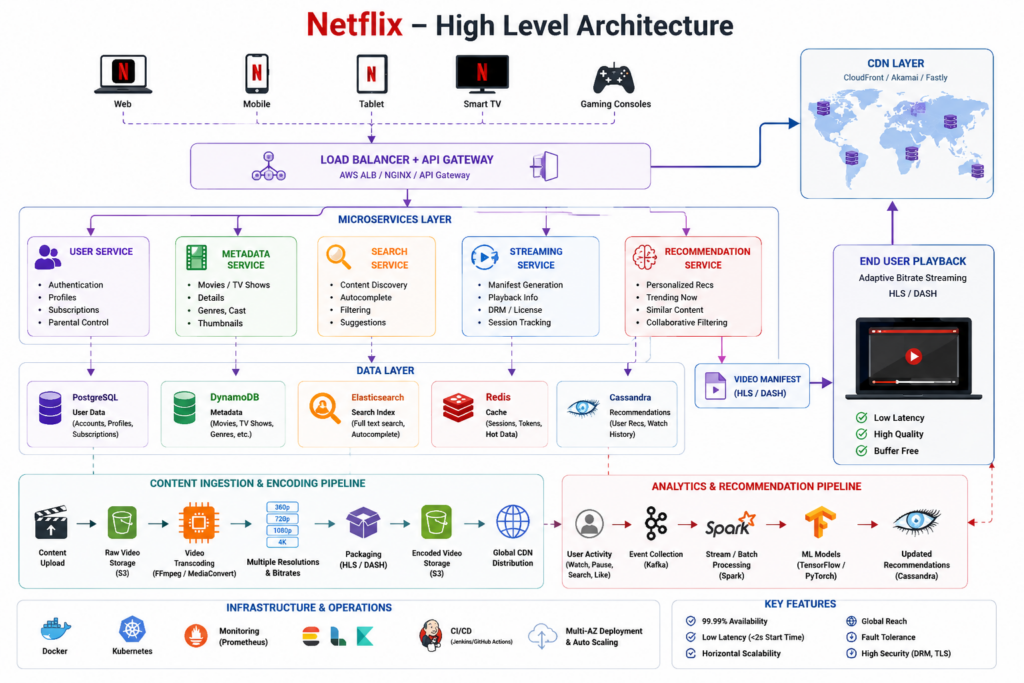
Major Components
- Client Apps (Web, Mobile, Smart TV)
- API Gateway + Load Balancer
- Microservices Layer
- Databases & Storage
- Video Encoding Pipeline
- Content Delivery Network (CDN)
- Recommendation Engine
- Search Service
High-Level Flow
- User opens appRequest goes to API Gateway
- AuthenticationUser service validates credentials
- Browse/SearchMetadata service + Elasticsearch return content
- Play VideoStreaming service provides manifest file (HLS/DASH)
- CDN DeliveryVideo chunks are fetched from nearest CDN edge server
- RecommendationsML service generates personalized suggestions
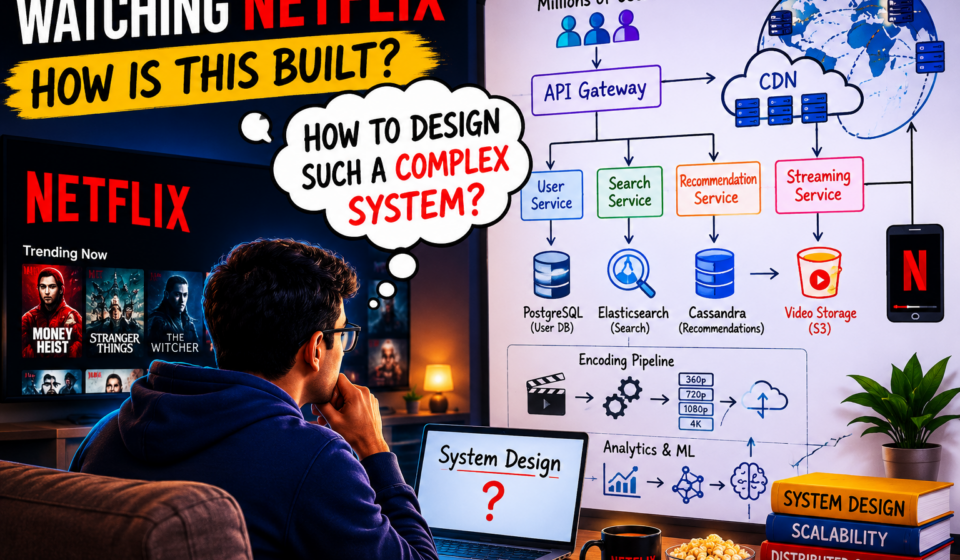
Here’s a high-level Netflix architecture diagram that you can draw in an interview whiteboard round:
                                   +------------------+
                                   |   Client Apps    |
                                   |------------------|
                                   | Web / Mobile / TV|
                                   +--------+---------+
                                            |
                                            v
                            +-------------------------------+
                            | Load Balancer + API Gateway   |
                            | (AWS ALB / Kong / NGINX)      |
                            +---------------+---------------+
                                            |
      ------------------------------------------------------------------
      |                 |                |               |              |
      v                 v                v               v              v

+------------+  +--------------+  +--------------+  +-----------+  +-------------+
| User       |  | Metadata     |  | Search       |  | Streaming |  | Recommendation|
| Service    |  | Service      |  | Service      |  | Service   |  | Service      |
+------------+  +--------------+  +--------------+  +-----------+  +-------------+
      |                |                 |                |               |
      v                v                 v                v               v

+------------+  +--------------+  +--------------+  +-----------+  +-------------+
| PostgreSQL |  | DynamoDB     |  | Elasticsearch|  | Redis     |  | Cassandra   |
| User Data  |  | Metadata     |  | Search Index |  | Sessions  |  | User Recs   |
+------------+  +--------------+  +--------------+  +-----------+  +-------------+

                                            |
                                            |
                                            v

                            +-------------------------------+
                            |   Video Manifest (HLS/DASH)   |
                            +---------------+---------------+
                                            |
                                            v

                            +-------------------------------+
                            |           CDN Layer           |
                            | CloudFront / Akamai / Fastly |
                            +---------------+---------------+
                                            |
                                            v

                            +-------------------------------+
                            |       End User Playback       |
                            +-------------------------------+


=========================================================================
                    CONTENT INGESTION & ENCODING PIPELINE
=========================================================================

        Content Studio Upload
                  |
                  v

         +------------------+
         | Raw Video Upload |
         +--------+---------+
                  |
                  v

         +------------------+
         | AWS S3 (Origin)  |
         +--------+---------+
                  |
                  v

         +---------------------------+
         | Video Encoding Service    |
         | FFmpeg / MediaConvert     |
         +------------+--------------+
                      |
      ------------------------------------------------
      |              |              |               |
      v              v              v               v

   360p          720p           1080p             4K

      ------------------------------------------------
                      |
                      v

         +---------------------------+
         | HLS/DASH Packaging        |
         | Manifest + Segments       |
         +------------+--------------+
                      |
                      v

         +---------------------------+
         | Encoded Video Storage     |
         | AWS S3                    |
         +------------+--------------+
                      |
                      v

         +---------------------------+
         | Global CDN Distribution   |
         +---------------------------+


=========================================================================
                       ANALYTICS & RECOMMENDATION FLOW
=========================================================================

      User Watches Content
                |
                v

      +-------------------+
      | Event Collection  |
      | Kafka             |
      +---------+---------+
                |
                v

      +-------------------+
      | Spark Processing  |
      +---------+---------+
                |
                v

      +-------------------+
      | ML Models         |
      | TensorFlow        |
      | PyTorch           |
      +---------+---------+
                |
                v

      +-------------------+
      | Cassandra         |
      | Recommendation DB |
      +-------------------+
Interview Explanation (30-second Summary)
- User requests hit Load Balancer + API Gateway.
- Gateway routes traffic to microservices:
- User Service → PostgreSQL
- Metadata Service → DynamoDB
- Search Service → Elasticsearch
- Recommendation Service → Cassandra
- Streaming Service returns an HLS/DASH manifest.
- Video chunks are served through a global CDN.
- Videos are stored in S3 and pre-transcoded into 360p, 720p, 1080p, 4K for adaptive bitrate streaming.
- User watch events flow into Kafka → Spark → ML Models → Cassandra to generate recommendations.
- Redis caches sessions and frequently accessed data.
- Services run on Kubernetes with auto-scaling to achieve 99.99% availability and support millions of users.
This is the architecture diagram typically expected in senior SDE/L4-L6 system design interviews at companies like Netflix, Amazon, Google, and Meta.
3. Client Applications
Supported Platforms
- Web (React/Angular)
- iOS/Android apps
- Smart TVs (Roku, Fire TV, Apple TV)
- Gaming consoles
Key Responsibilities
- User authentication
- Video player with adaptive bitrate streaming (ABR)
- Caching thumbnails and metadata
- Offline downloads (optional)
Tech Stack
- Frontend Web: React.js / Next.js
- Mobile: Swift (iOS), Kotlin (Android)
- TV Apps: Roku SDK, Fire TV SDK
4. API Gateway & Load Balancer
Purpose
- Single entry point for all client requests
- Routes requests to appropriate microservices
- Handles authentication, rate limiting, and monitoring
Tech Stack
- Load Balancer: AWS Application Load Balancer (ALB) / NGINX
- API Gateway: AWS API Gateway / Kong / Envoy
Why Important?
- Distributes traffic evenly
- Prevents service overload
- Improves reliability and scalability
5. Microservices Architecture
Netflix is best designed using microservices for independent scaling and deployment.
Core Services
1. User Service
Responsibilities
- Registration/login
- Profiles
- Subscriptions
- Session management
Tech Stack
- Language: Java / Spring Boot or Node.js
- Database: PostgreSQL
- Cache: Redis
2. Metadata Service
Responsibilities
- Stores movie/show details
- Genres, cast, ratings, thumbnails
Tech Stack
- Database: DynamoDB / MongoDB
- API: GraphQL or REST
3. Streaming Service
Responsibilities
- Generates playback URLs
- Provides HLS/DASH manifests
- Tracks viewing sessions
Tech Stack
- Language: Go / Java
- Protocol: HLS (HTTP Live Streaming), MPEG-DASH
4. Recommendation Service
Responsibilities
- Personalized content suggestions
- Trending and similar content
Tech Stack
- Database: Cassandra
- ML Frameworks: TensorFlow / PyTorch
- Processing: Apache Spark
5. Search Service
Responsibilities
- Content discovery
- Autocomplete and filtering
Tech Stack
- Search Engine: Elasticsearch
Why Microservices?
- Independent deployment
- Technology flexibility
- Better fault isolation
- Scales each service independently
6. Video Storage & Encoding Pipeline
Video Upload Flow
- Content uploadStudios upload raw video files
- StorageRaw files stored in object storage
- TranscodingConvert into multiple resolutions and bitrates
- PackagingGenerate HLS/DASH segments and manifests
- Store encoded filesStore processed videos in blob storage
- Distribute via CDNReplicate popular content globally
Adaptive Bitrate Streaming (ABR)
Why Needed?
Different users have different network speeds.
How It Works
A single video is encoded into multiple versions:
- 360p – low bandwidth
- 720p – HD
- 1080p – Full HD
- 4K – Ultra HD
The player automatically switches quality based on:
- Current bandwidth
- Device capability
- Buffer health
Tech Stack
- Object Storage: AWS S3 / Google Cloud Storage
- Transcoding: FFmpeg, AWS Elemental MediaConvert
- Streaming Formats: HLS, MPEG-DASH
7. Content Delivery Network (CDN)
Purpose
Deliver video content from servers closest to users.
How It Works
- User requests video segmentPlayer requests a video chunk
- CDN Edge CheckNearest edge server checks if chunk is cached
- Cache HitServe immediately for low latency
- Cache MissFetch from origin storage, cache it, then serve
Benefits
- Reduced latency
- Lower bandwidth costs
- Handles massive traffic spikes
- Improves video start time
Tech Stack
- CDN Providers: CloudFront, Akamai, Fastly
- Edge Caching: Popular content cached globally
8. Databases
Different data types need different databases.
Database Selection
| Data Type | Database | Why? |
|---|---|---|
| User accounts, billing | PostgreSQL | Strong consistency, relational queries |
| Recommendations | Cassandra | High write throughput, scalable |
| Content metadata | DynamoDB / MongoDB | Flexible schema, fast reads |
| Session tokens | Redis | In-memory, ultra-fast access |
| Search index | Elasticsearch | Full-text search and filtering |
Why Polyglot Persistence?
No single database is optimal for all workloads. Each service uses the database best suited for its needs.
9. Recommendation Engine
Goals
- Increase user engagement
- Improve watch time
- Personalize homepage
Approaches
1. Collaborative Filtering
- Users who watched similar content get similar recommendations.
- Example: “Users who watched Stranger Things also watched Dark.”
2. Content-Based Filtering
- Recommend content with similar genres, actors, or themes.
3. Machine Learning Models
- Deep learning models predict user preferences.
- Use watch history, ratings, time spent, device type, etc.
Architecture
- Data ingestion from user activity
- Batch processing with Spark
- Real-time recommendation serving via Cassandra
Tech Stack
- Data Processing: Apache Spark
- ML Frameworks: TensorFlow, PyTorch
- Serving DB: Cassandra
10. Search System
Requirements
- Full-text search
- Autocomplete
- Filtering by genre, year, language
- Typo tolerance
Solution
Use Elasticsearch to index content metadata.
Search Flow
- User types query
- API Gateway forwards to Search Service
- Elasticsearch returns ranked results
- Metadata service enriches response with thumbnails and details
11. Caching Strategy
Caching is critical for performance.
Cache Layers
1. CDN Edge Cache
- Cache popular video segments close to users.
2. Redis Cache
- Session tokens
- User profiles
- Frequently accessed metadata
- Recommendation results
3. Application Cache
- In-memory caching within services for hot data.
Benefits
- Reduces database load
- Improves response times
- Handles traffic spikes efficiently
12. Scalability & Reliability
Horizontal Scalability
- Use stateless microservices
- Auto-scale containers based on traffic
- Shard databases where needed
High Availability
- Deploy services across multiple availability zones
- Use database replication
- CDN provides geographic redundancy
Fault Tolerance
- Circuit breakers and retries
- Graceful degradation (e.g., recommendations unavailable but streaming still works)
- Health checks and auto-recovery
Tech Stack
- Containerization: Docker
- Orchestration: Kubernetes (EKS/GKE)
- Monitoring: Prometheus + Grafana
- Logging: ELK Stack (Elasticsearch, Logstash, Kibana)
13. Security Considerations
Key Security Measures
- HTTPS/TLS for all communication
- JWT/OAuth for authentication
- DRM (Digital Rights Management) for content protection
- Rate limiting and DDoS protection
- Encrypted storage for sensitive data
14. End-to-End Playback Flow
Complete Sequence
- User selects a movieThe client requests playback information
- Streaming Service respondsReturns an HLS/DASH manifest URL
- Client requests video segmentsRequests chunks from the nearest CDN edge
- CDN serves cached chunksIf cached, serve immediately; otherwise fetch from origin storage
- Adaptive bitrate adjustmentThe player continuously adjusts quality based on bandwidth
- Analytics sent backWatch progress and engagement data are sent for recommendations and monitoring
15. Final Architecture Summary
Tech Stack Overview
| Component | Tech Stack |
|---|---|
| Frontend Web | React.js / Next.js |
| Mobile Apps | Swift, Kotlin |
| API Gateway | AWS API Gateway / Kong |
| Load Balancer | AWS ALB / NGINX |
| Microservices | Java Spring Boot / Go / Node.js |
| User Database | PostgreSQL |
| Recommendation Database | Cassandra |
| Metadata Database | DynamoDB / MongoDB |
| Cache | Redis |
| Search Engine | Elasticsearch |
| Video Storage | AWS S3 |
| CDN | CloudFront / Akamai |
| Transcoding | FFmpeg / AWS MediaConvert |
| Orchestration | Kubernetes (EKS/GKE) |
| Monitoring | Prometheus + Grafana |
16. Interview Tips
How to Present in an Interview
- Start with requirements – show structured thinking.
- Draw a high-level architecture – identify major components first.
- Explain data flow – how a user request moves through the system.
- Discuss trade-offs – SQL vs NoSQL, monolith vs microservices, consistency vs availability.
- Address NFRs explicitly – scalability, latency, availability, caching, and fault tolerance.
- Conclude with bottlenecks and improvements – CDN optimization, prefetching, offline downloads, etc.
17. Common Follow-Up Questions
Be Ready to Answer
- How would you reduce video start time further?
- How do you handle a viral show causing massive traffic spikes?
- How would you support offline downloads?
- How do you ensure DRM and content security?
- How would you design live streaming instead of on-demand streaming?
Final Takeaway
A Netflix-like system is a combination of:
- Microservices for modularity and scalability
- CDNs for global low-latency delivery
- Adaptive bitrate streaming for smooth playback
- Polyglot databases for optimized storage
- Machine learning for personalized recommendations
- Robust caching and orchestration for high availability and performance
The key is to balance scalability, reliability, and user experience while supporting millions of concurrent viewers worldwide.