
Introduction
Over the past couple of years, we’ve all become familiar with AI tools like ChatGPT, Claude, Gemini, and Microsoft Copilot. They can answer questions, summarize documents, write emails, generate presentations, and even help us write code.
But today, the conversation has moved beyond chatbots.
Everyone is talking about AI Agents, MCP, and Agent-to-Agent communication.
Why?
Did ChatGPT suddenly become insufficient?
Not exactly.
The technology evolved because businesses needed AI to do more than just provide information—they needed AI to perform real work.
In this article, we’ll walk through that evolution step by step.
The Problem
Imagine you ask ChatGPT:
“Book me a flight from London to New York next Monday. I prefer a morning flight, an aisle seat, British Airways if possible, and my budget is under £700.”
ChatGPT does an excellent job.
It understands your request.
It considers your preferences.
It may even recommend the best flight.
But then…
Nothing happens.
The ticket isn’t booked.
Let’s try another example.
You ask:
“Send an email to my manager saying I’m not feeling well and won’t be coming to the office today.”
Again…
ChatGPT writes a professional email.
But it doesn’t actually send it.
So what’s missing?
What an LLM Can Actually Do
To answer that question, let’s first understand what powers ChatGPT.
Behind ChatGPT is a Large Language Model, or LLM.
Think of an LLM as an incredibly knowledgeable assistant.
It understands language.
It reasons over information.
It generates responses.
An LLM can:
- Answer questions
- Summarize documents
- Translate languages
- Generate reports
- Write emails
- Create presentations
- Write code
- Generate images
Notice a pattern.
Everything it produces is information.
An LLM is incredibly intelligent.
But by itself, it doesn’t perform actions.
Think of it this way.
An LLM has a brilliant brain.
But it has no hands.
It knows what should happen.
It doesn’t make it happen.
From Information to Action
Let’s return to our flight booking example.
Suppose ChatGPT has already done its job.
It understood your request.
It analyzed your travel preferences.
It even identified the best flight.
Now what?
Someone still needs to check seat availability.
Compare prices.
Complete the booking.
Process the payment.
Generate the confirmation.
Those are real-world actions.
They involve interacting with external systems.
This is where an LLM reaches its limit.
It can recommend.
It cannot execute.
To turn recommendations into actions, we need something more.
Enter AI Agents
This is where AI Agents come into the picture.
Think of ChatGPT as the intelligent advisor.
The AI Agent is the digital assistant that actually gets the work done.
Here’s what happens behind the scenes.
You ask ChatGPT to book your trip.
ChatGPT understands your request and determines what needs to be done.
It then hands the relevant details to an AI Agent.
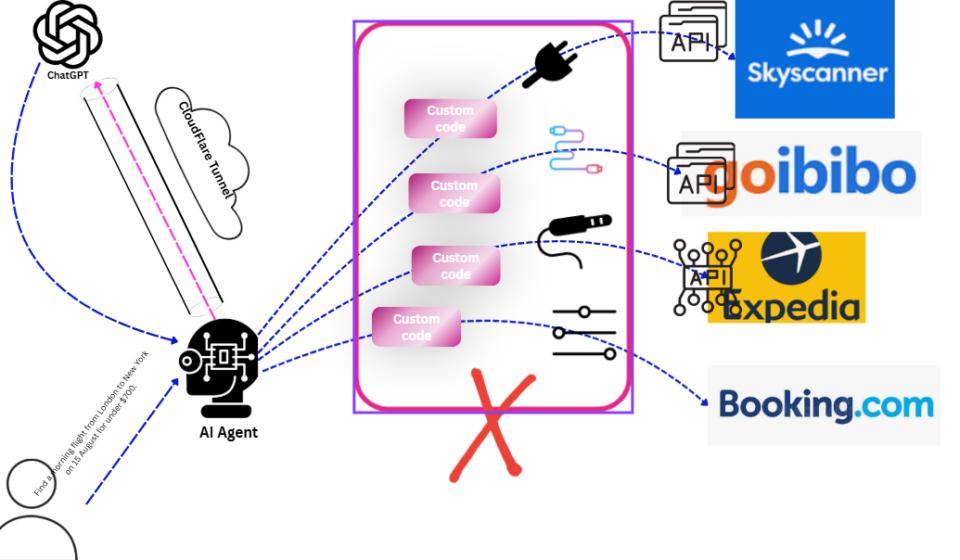
The AI Agent begins interacting with external booking platforms such as Skyscanner, Goibibo, Expedia, or the airline’s booking system.
It searches for flights.
Compares prices.
Checks seat availability.
Applies your preferences.
Selects the best option.
Completes the booking.
Finally, it returns the confirmation back to ChatGPT, which presents the result in a natural conversation.
In simple terms:
ChatGPT provides the intelligence.
The AI Agent performs the action.
Can You Build Your Own AI Agent?
Absolutely.
Today, organizations are building their own AI Agents to automate business processes.
Even platforms like ChatGPT and Claude offer agent capabilities in their paid plans.
Imagine an employee says:
“I’m joining the company next Monday.”
An AI Agent could automatically:
- Create the employee account
- Order a laptop
- Grant application access
- Schedule induction sessions
- Notify the manager
- Create payroll records
Instead of employees opening multiple applications, one AI Agent coordinates everything.
How Does an AI Agent Talk to Business Systems?
Now comes an important question.
How does an AI Agent communicate with external applications?
Let’s return to our travel booking example.
The AI Agent needs to communicate with platforms like Skyscanner, Goibibo, Expedia, airline systems, payment gateways, and hotel booking services.
However, these systems don’t automatically understand the AI Agent.
Someone has to build those connections.
Traditionally, developers write a separate integration for every external application.
One connector is written for Skyscanner.
Another for Goibibo.
Another for Expedia.
Each platform exposes different APIs.
Each uses different authentication methods.
Each expects different request formats.
Each returns different response structures.
The AI Agent needs a separate connector for every platform it wants to use.
Now imagine supporting dozens—or even hundreds—of business systems.
Every new application requires another custom integration.
This approach works.
But it quickly becomes expensive to build, difficult to maintain, and hard to scale.
Surely, there had to be a better way.
The Integration Challenge
Imagine buying a new phone charger for every electronic device you own.
One charger for your phone.
Another for your laptop.
Another for your smartwatch.
Another for your headphones.
Life would become frustrating.
Software integrations faced the same problem.
Every AI Agent had to learn a different language for every application.
The industry needed a universal standard.
Enter MCP
That standard is called the Model Context Protocol, or MCP.
Think of MCP as the USB-C of AI.
Years ago, every phone manufacturer had a different charging cable.
Today, USB-C has become a universal standard.
One cable works with many devices.
MCP aims to do the same for AI.
Instead of every AI Agent learning hundreds of different APIs, applications expose a standard MCP interface.
Once an AI Agent understands MCP, it can communicate with any MCP-compatible application.
Less custom development.
Less maintenance.
Greater interoperability.
How MCP Works
Imagine checking into a hotel.
You don’t walk into the kitchen to order food.
You don’t visit housekeeping directly.
You don’t go to accounting to settle your bill.
You simply speak to the receptionist.
The receptionist knows which department to contact.
MCP works the same way.
The AI Agent communicates with the MCP Server.
The MCP Server understands the application’s capabilities.
It translates requests into the format that application expects.
The application performs the work.
The response is translated back to the AI Agent.
Everything follows a common standard.
Putting It All Together
Let’s revisit our travel request.
You say:
“Book my London to New York trip, reserve a hotel near Times Square, add everything to my Outlook calendar, and email the itinerary to my team.”
Here’s what happens.
The LLM understands your request.
The AI Agent breaks it into tasks.
The Flight MCP Server books your flight.
The Hotel MCP Server reserves your hotel.
The Calendar MCP Server updates Outlook.
The Email MCP Server sends your itinerary.
Finally, ChatGPT informs you that everything is complete.
One conversation.
Multiple enterprise systems.
No manual effort.
The Next Evolution: Agent-to-Agent
As organizations adopt more AI Agents, another challenge appears.
Should one AI Agent do everything?
Probably not.
Instead, organizations are creating specialized AI Agents.
One Travel Agent.
One HR Agent.
One Finance Agent.
One Procurement Agent.
Each specializes in a specific business function.
Now imagine the Travel Agent also needs to book a hotel.
Rather than handling hotel bookings itself, it simply asks the Hotel Agent.
The Hotel Agent performs the task and returns the result.
This collaboration is known as Agent-to-Agent communication, or A2A.
Think of it like departments inside a company.
HR collaborates with IT.
Finance collaborates with Procurement.
Each team specializes in its own area but works together to complete larger business processes.
AI is evolving in exactly the same way.
Final Thoughts
The evolution of enterprise AI is surprisingly logical.
We started with Large Language Models that could understand language and generate information.
Businesses then wanted AI to perform actions, leading to AI Agents.
As organizations built more integrations, maintaining custom connectors became increasingly difficult.
To solve that problem, the industry introduced MCP—a common standard for connecting AI with enterprise systems.
And as AI ecosystems continue to grow, specialized AI Agents are beginning to collaborate using Agent-to-Agent communication.
If you remember just one thing, remember this:
- LLMs understand and reason.
- AI Agents execute tasks.
- MCP standardizes communication with external systems.
- Agent-to-Agent enables multiple AI specialists to collaborate.
Together, these technologies are transforming AI from a conversational assistant into a workforce of intelligent digital employees capable of automating real business processes.