
Large Language Models (LLMs) such as GPT, Claude, and Gemini are excellent at understanding language, reasoning, and generating human-like responses. However, they have one major limitation—they do not know your organization’s private knowledge unless you explicitly provide it.
Imagine asking an AI assistant:
“What’s the reimbursement policy for international travel?”
If the travel policy is an internal company document, the LLM cannot answer accurately because it has never seen your organization’s private data. It may simply respond:
“Sorry, I don’t know.”
This is where Retrieval-Augmented Generation (RAG) becomes essential.
Why Not Train the LLM with Company Documents?
Before diving into RAG, an obvious question comes to mind:
Why not simply provide our internal documents to the LLM and train it on our company knowledge?
Although this sounds like a good solution, it has several drawbacks.
- Company documents change frequently.
- Retraining or fine-tuning an LLM is expensive and time-consuming.
- New policies require retraining the model.
- The knowledge inside the model becomes outdated.
- It is difficult to identify which document was used to generate an answer.
For example, if your HR department updates the travel reimbursement policy today, a fine-tuned model would still answer using the old policy until it is retrained.
RAG solves this problem by keeping the documents outside the LLM and retrieving only the relevant information when needed.
What is RAG?
Retrieval-Augmented Generation (RAG) is a technique that allows an AI application to retrieve relevant information from internal documents before sending the user’s question to the LLM.
Instead of storing company knowledge inside the model, RAG stores it in a searchable knowledge base.
When a user asks a question, the AI retrieves only the relevant document sections and sends them to the LLM as context.
The LLM then generates its answer using that context.
Where Does RAG Fit?
A typical enterprise architecture looks like this:
User
   │
   ▼
AI Agent
   │
   ├── Already knows the answer?
   │
   ├── Yes ─────────► LLM
   │
   └── No
        │
        ▼
       RAG
        │
        ▼
Vector Database
        │
        ▼
Relevant Document Chunks
        │
        ▼
LLM
        │
        ▼
AI Agent
        │
        ▼
User
The AI agent decides whether internal company knowledge is required.
If yes, it invokes the RAG system.
How RAG Works
RAG consists of two independent pipelines.
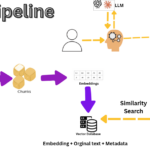
Pipeline 1 – Document Ingestion
This pipeline prepares company documents for searching.
- Read documents from PDFs, Word files, SharePoint, Confluence, or internal wiki pages.
- Split large documents into smaller chunks.
- Convert each chunk into an embedding.
- Store the embedding, original text, and metadata in a vector database.
For every chunk, the vector database stores:
- Embedding
- Original text
- Metadata (source, page number, document name, etc.)
The embedding is used for searching.
The original text is later sent to the LLM.
Pipeline 2 – Query Pipeline
Whenever a user asks a question:
- Convert the user’s question into an embedding.
- Search the vector database using similarity search algorithms such as Cosine Similarity or Approximate Nearest Neighbor (ANN).
- Retrieve the most relevant document chunks.
- Send the retrieved text together with the user’s question to the LLM.
- The LLM generates an answer using the retrieved company knowledge.
- The AI agent returns the final response to the user.
Notice that the LLM never receives embeddings.
It receives only the retrieved text.
Why Do We Need an AI Agent?
A simple chatbot forwards every question directly to an LLM.
An enterprise AI application must do much more.
It needs to:
- Plan tasks
- Remember previous conversations
- Decide which tools to use
- Determine when RAG is required
- Connect to databases
- Invoke MCP servers
- Call external APIs
- Execute workflows
The AI agent becomes the orchestrator of the entire system.
Why Do We Need a Framework Like LangChain?
Initially, building an AI assistant is straightforward.
The user sends a request to your Python application.
Your Python application forwards the request to GPT or Claude.
For simple conversations, this approach works perfectly.
As your application grows, however, it needs to:
- Manage prompt templates
- Maintain conversation history
- Search company documents using RAG
- Connect to databases
- Call external APIs
- Invoke MCP servers
- Execute multiple tools
- Decide which tool to use
- Coordinate multi-step workflows
- Support multiple LLM providers
Without a framework, you would have to write all of this orchestration logic yourself.
As the application grows, the code quickly becomes difficult to maintain and extend.
This is exactly why frameworks like LangChain exist.
What is LangChain?
LangChain is an open-source framework that simplifies building applications powered by large language models.
Instead of writing custom orchestration code, LangChain provides reusable components for:
- LLM integration
- Prompt templates
- Memory
- RAG
- Tool calling
- Agents
- Workflows
- Output parsers
LangChain acts as the coordinator between the LLM and all external systems.
Flight Booking Example
Consider the following request:
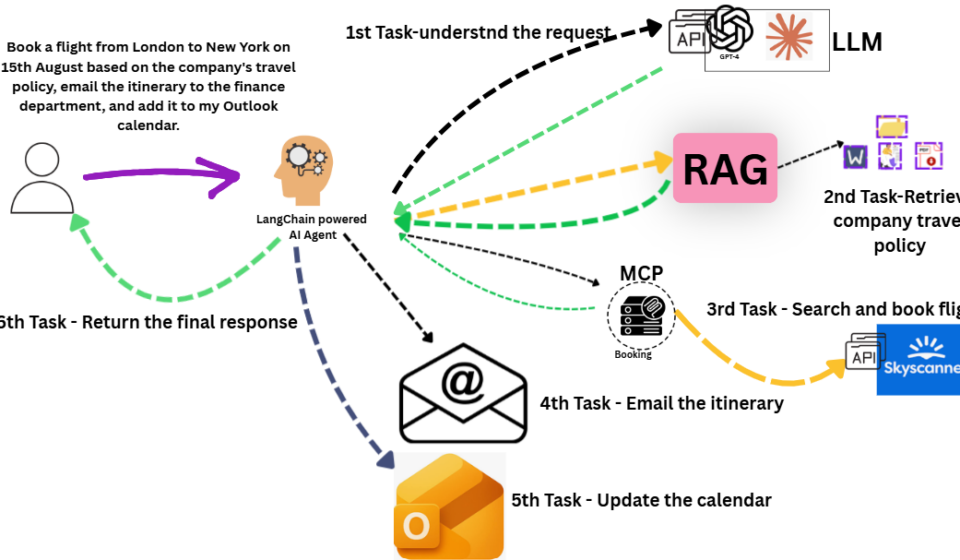
“Book a flight from London to New York on 15th August based on the company’s travel policy, email the itinerary to the finance department, and add it to my Outlook calendar.”
LangChain recognizes that this cannot be solved with a single LLM prompt.
It requires reasoning, retrieval, and multiple tool invocations.
The workflow looks like this:
Step 1
The AI agent invokes an LLM such as GPT or Claude to understand the user’s request and extract key details including:
- Departure city
- Destination
- Travel date
- Required actions
Step 2
The agent determines that company travel policies are required.
It invokes the RAG system.
Step 3
RAG retrieves the company’s travel policy, including:
- Maximum airfare
- Cabin class rules
- Booking guidelines
Step 4
Using the retrieved policy, the AI agent invokes a flight booking MCP server or travel API to search for flights that comply with company policy.
Step 5
The AI agent books the selected flight.
Step 6
The agent invokes an email tool to send the itinerary to the finance department.
Step 7
The agent invokes Outlook Calendar to create the travel event.
Step 8
Finally, the AI agent returns a single response:
“Your flight has been booked, the itinerary has been emailed to the finance department, and the trip has been added to your Outlook calendar.”
Throughout this process, LangChain orchestrates every step.
It coordinates the LLM, RAG, APIs, MCP servers, and external tools, passing the output from one step to the next until the workflow is complete.
Popular RAG Frameworks
Several frameworks simplify building RAG applications.
- LangChain – Comprehensive framework for agents, RAG, tools, memory, and workflows.
- LlamaIndex – Specializes in indexing and retrieving enterprise data for LLM applications.
- Haystack – Production-ready framework for search, question answering, and RAG.
- RAGFlow – End-to-end platform for document ingestion, indexing, retrieval, and enterprise RAG workflows.
Conclusion
Modern enterprise AI applications require much more than a powerful LLM.
They need access to private company knowledge, the ability to reason about user requests, and the capability to execute complex workflows involving multiple tools and services.
RAG enables AI systems to retrieve the latest internal knowledge without retraining the model, while LangChain provides the orchestration layer that coordinates LLMs, RAG, APIs, MCP servers, and external tools into a single intelligent workflow.
Together, they form the foundation of scalable, production-ready AI applications.