
High level architecture
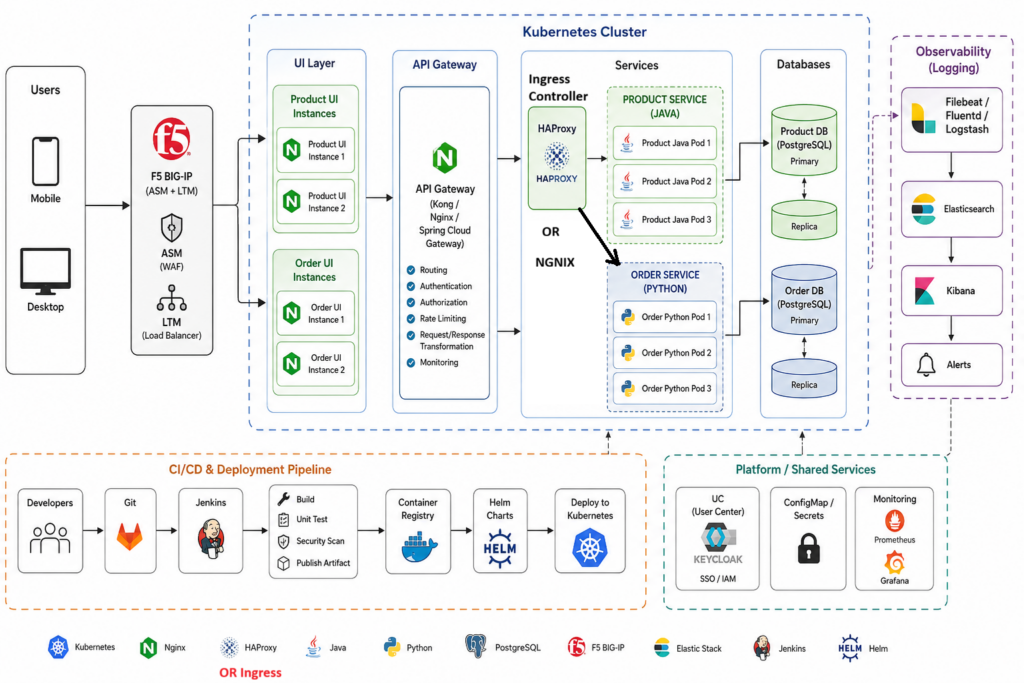
This is our target
Architecture Flow
Users (Mobile/Desktop) → F5 (ASM + LTM) → UI Layer → API Gateway → Service Layer → Databases → Logging/Monitoring
The design follows a highly available microservices architecture deployed on Kubernetes, with separate Product and Order domains.
1. User Layer
Mobile & Desktop Clients
These are the consumer channels accessing the platform.
Responsibilities
- User interaction
- Authentication initiation
- Request generation
- Displaying Product and Order information
NFR Mapping
| NFR | Contribution |
|---|---|
| Usability | Responsive UI across devices |
| Accessibility | Support for different browsers and devices |
| Performance | Fast page rendering |
| Availability | Multiple UI instances ensure continuity |
2. F5 Layer (ASM + LTM)
F5 BIG-IP
ASM (Application Security Manager)
Acts as a Web Application Firewall (WAF).
Responsibilities
- OWASP Top 10 protection
- SQL injection prevention
- XSS protection
- Bot mitigation
- Request filtering
LTM (Local Traffic Manager)
Acts as the external load balancer.
Responsibilities
- Traffic distribution
- Health checks
- SSL termination
- Failover routing
NFR Mapping
| NFR | Contribution |
|---|---|
| Security | WAF protection |
| Availability | Load balancing and failover |
| Reliability | Health monitoring |
| Scalability | Traffic distribution |
| Performance | SSL offloading |
3. UI Layer
Product UI Instances (2)
- Product UI Instance 1
- Product UI Instance 2
Order UI Instances (2)
- Order UI Instance 1
- Order UI Instance 2
Responsibilities
- Presentation layer
- User session handling
- API consumption
- Client-side validation
NFR Mapping
| NFR | Contribution |
|---|---|
| Availability | Active-active deployment |
| Scalability | Horizontal scaling |
| Performance | Reduced user latency |
| Maintainability | Independent UI deployments |
4. API Gateway
Possible implementations:
Responsibilities
- Request routing
- Authentication
- Authorization
- Rate limiting
- API versioning
- Request transformation
- Centralized logging
NFR Mapping
| NFR | Contribution |
|---|---|
| Security | Authentication & authorization |
| Performance | Intelligent routing |
| Scalability | Gateway clustering |
| Maintainability | Central API management |
| Observability | Request tracing |
5. Product Service Domain
HAProxy – you can use Ingress as well.
Load balances traffic across Product pods.
Product Java Pods (3)
Responsibilities
- Product catalog
- Inventory
- Pricing
- Product search
NFR Mapping
| NFR | Contribution |
|---|---|
| Availability | 3 pods with failover |
| Scalability | Horizontal pod scaling |
| Performance | Parallel processing |
| Reliability | Pod redundancy |
| Maintainability | Microservice isolation |
6. Order Service Domain
HAProxy
Load balances requests to Order services.
Order Python Pods (3)
Responsibilities
- Order creation
- Order validation
- Payment orchestration
- Fulfillment workflows
NFR Mapping
| NFR | Contribution |
|---|---|
| Availability | Multiple pods |
| Reliability | Failover support |
| Scalability | Scale independently from Product service |
| Maintainability | Domain separation |
| Performance | Concurrent request handling |
7. Database Layer
Product Database
Stores:
- Products
- Inventory
- Pricing
Order Database
Stores:
- Orders
- Transactions
- Order status
Primary + Replica Configuration
Benefits
- Read scaling
- Disaster recovery
- Backup support
- Reduced database bottlenecks
NFR Mapping
| NFR | Contribution |
|---|---|
| Availability | Replication |
| Reliability | Data redundancy |
| Performance | Read replicas |
| Recoverability | Backup and restore |
| Integrity | ACID transactions |
8. Logging Platform (ELK)
Components
Elastic Stack (ELK)
- Filebeat / Fluentd / Logstash
- Elasticsearch
- Kibana
Responsibilities
- Centralized logging
- Log aggregation
- Search and analytics
- Audit trail
- Incident investigation
NFR Mapping
| NFR | Contribution |
|---|---|
| Observability | Central log visibility |
| Auditability | Security and compliance logs |
| Reliability | Faster troubleshooting |
| Maintainability | Root cause analysis |
9. Monitoring Layer
Prometheus + Grafana
- Metrics collection
- Alerting
- Dashboarding
- Capacity planning
NFR Mapping
| NFR | Contribution |
|---|---|
| Observability | Real-time monitoring |
| Availability | Early failure detection |
| Reliability | SLA tracking |
| Performance | Bottleneck identification |
10. CI/CD Pipeline
Source Control
GitLab (or GitHub)
Stores source code.
Build & Deployment
Jenkins
Pipeline stages:
- Build
- Unit Test
- Security Scan
- Package
- Publish Artifact
- Deploy
Kubernetes Packaging
Helm
Manages Kubernetes deployments.
NFR Mapping
| NFR | Contribution |
|---|---|
| Deployability | Automated releases |
| Reliability | Consistent deployments |
| Security | Automated scans |
| Maintainability | Versioned releases |
| Recoverability | Rollback support |
11. Kubernetes Platform
Kubernetes
Responsibilities
- Container orchestration
- Auto-scaling
- Self-healing
- Rolling updates
- Service discovery
NFR Mapping
| NFR | Contribution |
|---|---|
| Availability | Self-healing pods |
| Scalability | HPA/Cluster scaling |
| Reliability | Automated recovery |
| Maintainability | Declarative deployment |
| Deployability | Rolling upgrades |
12. UC (User Center / IAM)
A centralized identity provider, commonly implemented using Keycloak.
Responsibilities
- SSO
- OAuth2/OpenID Connect
- User management
- Role-based access control
NFR Mapping
| NFR | Contribution |
|---|---|
| Security | Central identity management |
| Compliance | Access auditing |
| Usability | Single sign-on |
| Maintainability | Centralized authentication |
End-to-End NFR Coverage Matrix
| NFR | Components Supporting It |
|---|---|
| Availability | F5 LTM, API Gateway, HAProxy, Kubernetes, Multi-Pod Deployment, DB Replicas |
| Scalability | Kubernetes, HAProxy, API Gateway, Horizontal UI Scaling |
| Performance | F5, API Gateway, HAProxy, Read Replicas |
| Security | F5 ASM, API Gateway, Keycloak, TLS, Security Scans |
| Reliability | Kubernetes Self-Healing, Replicated Databases, Multiple Pods |
| Maintainability | Microservices, Helm, Jenkins, Central Logging |
| Observability | ELK, Prometheus, Grafana |
| Recoverability | Database Replicas, Helm Rollbacks, CI/CD |
| Deployability | Jenkins, Helm, Kubernetes |
| Auditability | ELK, Keycloak, API Gateway Logs |
This architecture would typically support enterprise targets such as 99.9–99.95% availability, horizontal scaling, centralized security controls, automated deployments, and full observability across Product and Order domains.
GCP Equivalent architecture