How to draw architecture diagram of your current project (web application) google cloud- GCP?

High level architecture
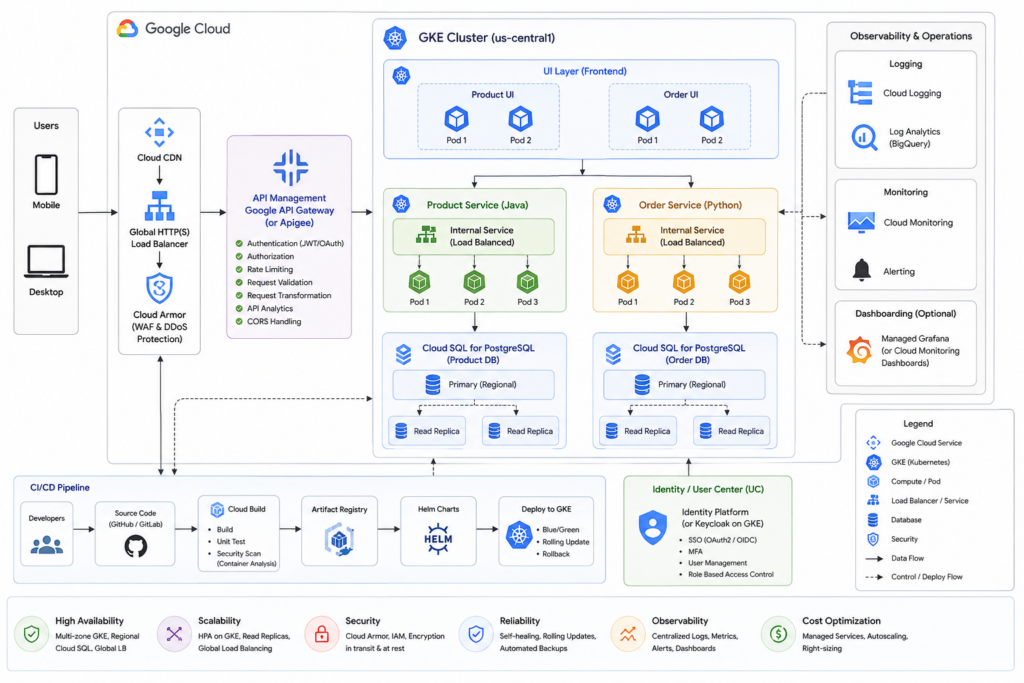
Google Cloud Architecture
Your current architecture can be modernized on Google Cloud using managed services while keeping the same logical flow.
Users (Mobile/Desktop)
        │
        ▼
Cloud Load Balancer + Cloud Armor
        │
        ▼
Frontend/UI Layer
(2 Product UI Pods, 2 Order UI Pods)
Hosted on GKE
        │
        ▼
API Gateway
(Google API Gateway / Apigee)
        │
 ┌──────┴─────────┐
 │                │
 ▼                ▼

Product Service    Order Service
   Route              Route

Internal Load Balancer
       │
 ┌─────┴─────┐
 ▼           ▼

Product Namespace
(GKE)
3 Java Pods

Order Namespace
(GKE)
3 Python Pods

       │
       ▼

Cloud SQL
(Product DB)

Cloud SQL
(Order DB)

Read Replicas
Component Mapping
| Hybrid Architecture | Google Cloud Equivalent |
|---|---|
| F5 ASM | Cloud Armor |
| F5 LTM | Global HTTP(S) Load Balancer |
| UI Instances | GKE Deployments |
| API Gateway | Google API Gateway or Apigee |
| HAProxy/Ingress | GKE Service + Internal Load Balancer |
| Java Pods | GKE Java Deployment |
| Python Pods | GKE Python Deployment |
| Databases | Cloud SQL PostgreSQL |
| ELK | Cloud Logging + Cloud Monitoring or Elastic on GCP |
| Jenkins | Cloud Build / Jenkins on GKE |
| Helm | Helm on GKE |
| Keycloak (UC) | Keycloak on GKE or Identity Platform |
| Kubernetes | GKE |
| Container Registry | Artifact Registry |
Detailed Architecture
1. Edge Layer
Cloud Load Balancer
Equivalent to F5 LTM.
Responsibilities
- SSL termination
- Global traffic distribution
- Health checks
- Cross-region routing
Cloud Armor
Equivalent to F5 ASM.
Responsibilities
- WAF
- DDoS protection
- Rate limiting
- OWASP Top 10 protection
- Geo-blocking
NFR Coverage
| NFR | GCP Service |
|---|---|
| Security | Cloud Armor |
| Availability | Global Load Balancer |
| Performance | Edge POPs |
| Reliability | Health checks |
2. UI Layer
Google Kubernetes Engine (GKE)
Deploy:
Product UI
  ├─ Pod 1
  └─ Pod 2

Order UI
  ├─ Pod 1
  └─ Pod 2
NFR Coverage
| NFR | Implementation |
|---|---|
| Availability | Multi-pod deployment |
| Scalability | HPA |
| Performance | CDN integration |
| Maintainability | Separate deployments |
3. API Management Layer
Option 1: Google API Gateway
Suitable for medium-sized workloads.
Option 2: Apigee
Enterprise-grade API management.
Features:
- OAuth
- JWT Validation
- Rate limiting
- Monetization
- API Analytics
NFR Coverage
| NFR | Implementation |
|---|---|
| Security | Authentication |
| Observability | API Analytics |
| Scalability | Managed gateway |
| Governance | API lifecycle management |
4. Product Domain
Product Namespace (GKE)
product-service
├── Java Pod 1
├── Java Pod 2
└── Java Pod 3
Use:
- Deployment
- HPA
- ClusterIP Service
Instead of HAProxy:
GKE Service
+
Internal Load Balancer
NFR Coverage
| NFR | Implementation |
|---|---|
| Scalability | HPA |
| Reliability | Multiple replicas |
| Availability | Self-healing |
| Maintainability | Microservice isolation |
5. Order Domain
Order Namespace (GKE)
order-service
├── Python Pod 1
├── Python Pod 2
└── Python Pod 3
Use:
- Deployment
- HPA
- ClusterIP Service
NFR Coverage
| NFR | Implementation |
|---|---|
| Availability | Multi-pod |
| Scalability | Auto scaling |
| Reliability | Pod failover |
| Maintainability | Independent deployments |
6. Database Layer
Cloud SQL for PostgreSQL
Product Database
Primary
 ├─ Read Replica 1
 └─ Read Replica 2
Order Database
Primary
 ├─ Read Replica 1
 └─ Read Replica 2
Recommended:
- Regional deployment
- Automatic backups
- PITR (Point-in-Time Recovery)
NFR Coverage
| NFR | Implementation |
|---|---|
| Availability | HA Cloud SQL |
| Reliability | Replication |
| Recoverability | PITR |
| Performance | Read replicas |
7. Logging Architecture
Instead of ELK:
Native GCP
Pods
  │
  ▼
Cloud Logging
  │
  ▼
Log Analytics
(BigQuery)
Optional:
Elastic Cloud
on Google Cloud
NFR Coverage
| NFR | Implementation |
|---|---|
| Auditability | Central logs |
| Observability | Managed logging |
| Maintainability | Log retention |
8. Monitoring Architecture
Cloud Monitoring
Equivalent to Prometheus + Grafana.
GKE Metrics
Cloud SQL Metrics
Load Balancer Metrics
Application Metrics
        │
        ▼
Cloud Monitoring
        │
        ▼
Alert Policies
Optional:
- Managed Prometheus
- Managed Grafana
NFR Coverage
| NFR | Implementation |
|---|---|
| Availability | Alerts |
| Performance | Metrics |
| Reliability | SLO monitoring |
9. CI/CD Pipeline
Recommended GCP Pipeline
Developer
   │
   ▼
GitHub/GitLab
   │
   ▼
Cloud Build
   │
   ▼
Security Scan
(Container Analysis)
   │
   ▼
Artifact Registry
   │
   ▼
Helm Chart
   │
   ▼
GKE Deployment
Alternative:
GitHub
   │
Jenkins
   │
Artifact Registry
   │
Helm
   │
GKE
NFR Coverage
| NFR | Implementation |
|---|---|
| Deployability | Automated pipelines |
| Security | Image scanning |
| Recoverability | Rollbacks |
| Maintainability | GitOps support |
10. User Center (UC)
Option 1 (Recommended)
Google Cloud Identity Platform
Features:
- OAuth2
- OIDC
- MFA
- SSO
- Social Login
Option 2
Keycloak deployed on GKE.
NFR Coverage
| NFR | Implementation |
|---|---|
| Security | IAM |
| Compliance | Audit logs |
| Usability | SSO |
| Maintainability | Central identity |
Target Enterprise GCP Architecture
Users
  │
  ▼
Cloud CDN
  │
  ▼
Cloud Load Balancer
  │
  ▼
Cloud Armor
  │
  ▼
API Gateway / Apigee
  │
  ▼
GKE Cluster
 ├── Product UI Pods (2)
 ├── Order UI Pods (2)
 ├── Product Service Java Pods (3)
 └── Order Service Python Pods (3)
  │
  ▼
Cloud SQL PostgreSQL
(Product DB + Replicas)

Cloud SQL PostgreSQL
(Order DB + Replicas)

Logging:
Cloud Logging

Monitoring:
Cloud Monitoring
Managed Prometheus
Managed Grafana

CI/CD:
GitHub → Cloud Build → Artifact Registry → Helm → GKE

Identity:
Identity Platform / Keycloak
This GCP version removes most self-managed infrastructure (F5, HAProxy, ELK servers, monitoring servers) and replaces them with managed Google Cloud services, improving operational efficiency while supporting enterprise targets such as 99.95% availability, auto-scaling, disaster recovery, centralized security, and full observability.