
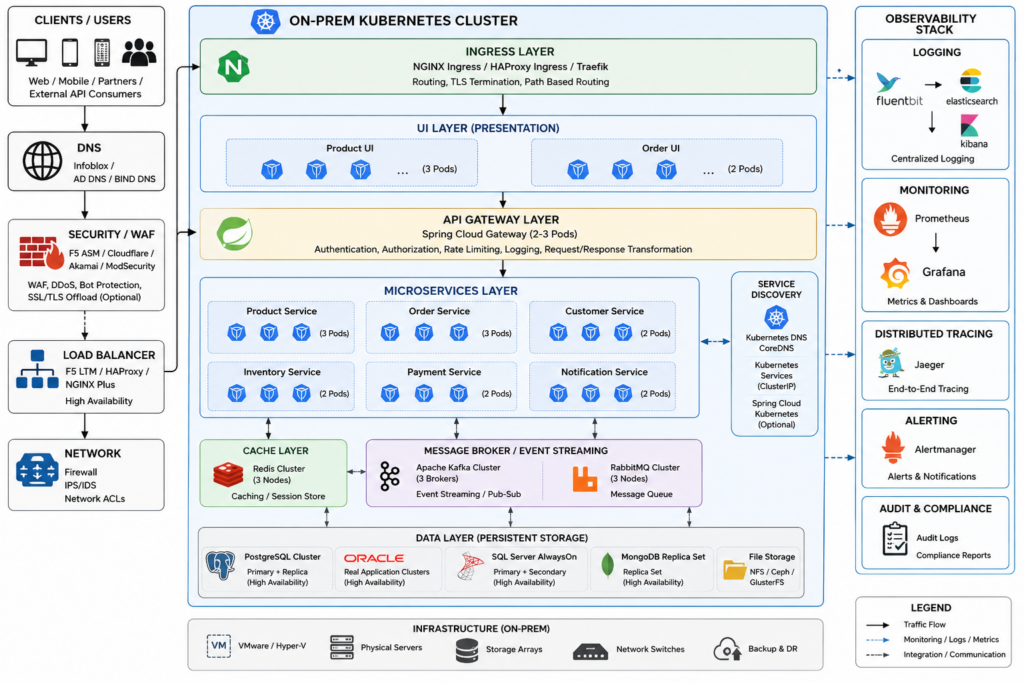
On-Prem Enterprise Kubernetes Architecture Diagram:
┌─────────────────────────────────────────────────────────────┐
│                     EXTERNAL USERS                          │
├─────────────────────────────────────────────────────────────┤
│ Desktop Browser │ Mobile Browser │ Mobile App │ Partners    │
└─────────────────────────────────────────────────────────────┘
                              │
                              ▼
┌─────────────────────────────────────────────────────────────┐
│                           DNS                               │
├─────────────────────────────────────────────────────────────┤
│ Infoblox │ Active Directory DNS │ BIND DNS                 │
└─────────────────────────────────────────────────────────────┘
                              │
                              ▼
┌─────────────────────────────────────────────────────────────┐
│                    SECURITY LAYER                           │
├─────────────────────────────────────────────────────────────┤
│ F5 ASM / Cloudflare / Akamai / ModSecurity                 │
│ (WAF, DDoS Protection, Bot Protection, SSL)               │
└─────────────────────────────────────────────────────────────┘
                              │
                              ▼
┌─────────────────────────────────────────────────────────────┐
│                  LOAD BALANCER LAYER                        │
├─────────────────────────────────────────────────────────────┤
│ F5 LTM / HAProxy / NGINX Plus                              │
└─────────────────────────────────────────────────────────────┘
                              │
                              ▼
┌─────────────────────────────────────────────────────────────┐
│                  INGRESS CONTROLLER                         │
├─────────────────────────────────────────────────────────────┤
│ NGINX Ingress / HAProxy Ingress / Traefik                  │
└─────────────────────────────────────────────────────────────┘
                              │
                              ▼

═══════════════════════════════════════════════════════════════════════
                    ON-PREMISE KUBERNETES CLUSTER
═══════════════════════════════════════════════════════════════════════

┌─────────────────────────────────────────────────────────────┐
│                        UI LAYER                             │
├─────────────────────────────────────────────────────────────┤
│ Product-UI Service                                          │
│ ├─ product-ui-pod-1                                         │
│ ├─ product-ui-pod-2                                         │
│ └─ product-ui-pod-3                                         │
│                                                             │
│ Order-UI Service                                            │
│ ├─ order-ui-pod-1                                           │
│ └─ order-ui-pod-2                                           │
└─────────────────────────────────────────────────────────────┘
                              │
                              ▼

┌─────────────────────────────────────────────────────────────┐
│                    API GATEWAY LAYER                        │
├─────────────────────────────────────────────────────────────┤
│ Spring Cloud Gateway Service                               │
│ ├─ gateway-pod-1                                            │
│ ├─ gateway-pod-2                                            │
│ └─ gateway-pod-3                                            │
└─────────────────────────────────────────────────────────────┘
                              │
                              ▼

┌─────────────────────────────────────────────────────────────┐
│                   MICROSERVICES LAYER                       │
├─────────────────────────────────────────────────────────────┤
│ Product Service (ClusterIP)                                │
│ ├─ product-svc-pod-1                                        │
│ ├─ product-svc-pod-2                                        │
│ └─ product-svc-pod-3                                        │
│                                                             │
│ Order Service (ClusterIP)                                  │
│ ├─ order-svc-pod-1                                          │
│ ├─ order-svc-pod-2                                          │
│ └─ order-svc-pod-3                                          │
└─────────────────────────────────────────────────────────────┘
                              │
              ┌───────────────┴───────────────┐
              ▼                               ▼

┌─────────────────────────┐     ┌─────────────────────────┐
│      CACHE LAYER        │     │    MESSAGE BROKER       │
├─────────────────────────┤     ├─────────────────────────┤
│ Redis                   │     │ Kafka                   │
│ Hazelcast               │     │ RabbitMQ               │
└─────────────────────────┘     └─────────────────────────┘
              │                               │
              └───────────────┬───────────────┘
                              ▼

┌─────────────────────────────────────────────────────────────┐
│                    DATABASE LAYER                           │
├─────────────────────────────────────────────────────────────┤
│ PostgreSQL Primary                                          │
│ PostgreSQL Replica                                          │
│                                                             │
│ OR                                                          │
│                                                             │
│ Oracle RAC                                                  │
│ SQL Server AlwaysOn                                         │
└─────────────────────────────────────────────────────────────┘

═══════════════════════════════════════════════════════════════════════
                       OBSERVABILITY STACK
═══════════════════════════════════════════════════════════════════════

┌─────────────────────────────────────────────────────────────┐
│ LOGGING                                                     │
├─────────────────────────────────────────────────────────────┤
│ Fluent Bit → Elasticsearch/OpenSearch → Kibana            │
│ Splunk                                                     │
└─────────────────────────────────────────────────────────────┘

┌─────────────────────────────────────────────────────────────┐
│ MONITORING                                                  │
├─────────────────────────────────────────────────────────────┤
│ Prometheus → Grafana                                       │
│ Zabbix / Nagios                                            │
└─────────────────────────────────────────────────────────────┘

┌─────────────────────────────────────────────────────────────┐
│ DISTRIBUTED TRACING                                         │
├─────────────────────────────────────────────────────────────┤
│ Jaeger / Tempo / Zipkin                                    │
└─────────────────────────────────────────────────────────────┘
Traffic Flow
User
 ↓
DNS
 ↓
WAF (F5 ASM)
 ↓
Load Balancer (F5 LTM)
 ↓
NGINX Ingress
 ↓
Product UI / Order UI
 ↓
Spring Cloud Gateway
 ↓
Product Service / Order Service
 ↓
Redis / Kafka
 ↓
Database
External API Consumer Flow
Partner System
      ↓
F5 ASM
      ↓
F5 LTM
      ↓
NGINX Ingress
      ↓
Spring Cloud Gateway
      ↓
Product Service / Order Service
Internal Service Communication
Gateway
   ↓
product-svc (ClusterIP)
   ↓
product pods

Gateway
   ↓
order-svc (ClusterIP)
   ↓
order pods
This is a realistic enterprise on-prem architecture suitable for banks, insurance, retail, telecom, and large-scale Java/Spring microservices platforms.
Below is a detailed explanation of each layer, why it exists, what problems it solves, and what happens if you don’t have it.
1. Client Layer
Desktop Browser
Mobile Browser
Mobile App
Partner Systems
Purpose
This is where requests originate.
Examples:
- Customer opens website
- Mobile app calls APIs
- External partner consumes APIs
- Internal applications integrate with your platform
Why Needed?
Without clients, there is no traffic.
Different clients have different requirements:
| Client | Typical Need |
|---|---|
| Browser | HTML/CSS/JS |
| Mobile App | JSON APIs |
| Partner System | Secure API Integration |
Example
User
 |
https://shop.company.com
2. DNS Layer
Infoblox
AD DNS
BIND
Purpose
Convert:
shop.company.cominto
10.10.20.100Why Needed?
Humans remember:
api.company.comnot
10.20.30.40Without DNS
Users would need to type IP addresses.
Impossible at enterprise scale.
3. Security / WAF Layer
F5 ASM
Cloudflare
Akamai
ModSecurity
Purpose
Protect applications before requests enter your environment.
Typical Attacks
SQL Injection
' OR 1=1 --Cross Site Scripting
<script>alert('hack')</script>API Abuse
1,000,000 requests/minuteDDoS
Millions of fake requestsWhy Needed?
Without WAF:
Internet
   |
Application
Attackers directly hit application.
With WAF:
Internet
   |
WAF
   |
Application
Bad requests are blocked.
4. Load Balancer Layer
F5 LTM
HAProxy
NGINX Plus
Purpose
Distribute traffic across multiple application instances.
Example:
10000 Requests
       |
Load Balancer
   /     |      \
App1   App2   App3
Why Needed?
Without LB:
Users
  |
App1
If App1 crashes:
Application DownWith LB:
Users
  |
LB
 / \
A1 A2
Traffic automatically shifts.
5. Ingress Controller
NGINX Ingress
HAProxy Ingress
Traefik
Purpose
Acts as Kubernetes entry point.
Routes requests.
Example:
/api/*
   |
Gateway

/shop/*
   |
Product UI

/orders/*
   |
Order UI
Why Needed?
Without Ingress:
Every service needs external exposure.
product-ui
order-ui
gateway
Each needs:
LoadBalancer
NodePort
Hard to manage.
Ingress centralizes access.
6. UI Layer
Product UI
Order UI
Purpose
Present information to users.
Example:
React
Angular
Vue
Responsibilities
- Render pages
- Display products
- Accept user input
- Call APIs
Why Needed?
Users do not call databases.
Users interact with UI.
Example:
User
 |
Product UI
 |
Gateway
7. API Gateway Layer
Spring Cloud Gateway
Kong
Apigee
Purpose
Single entry point for APIs.
Responsibilities
Authentication
JWT Validation
OAuth2
Authorization
Can user access API?Rate Limiting
100 req/minLogging
Capture request detailsRouting
/products -> product-service
/orders -> order-service
Why Needed?
Without Gateway:
Internet
 |
Product Service

Internet
 |
Order Service
Every service becomes internet-facing.
Security nightmare.
8. Microservices Layer
Product Service
Order Service
Payment Service
Inventory Service
Purpose
Implement business logic.
Example:
Product Service
Search Products
Create Products
Update Products
Order Service
Create Order
Cancel Order
Track Order
Why Needed?
Separation of concerns.
Instead of:
Huge MonolithUse:
Product Team
Order Team
Payment Team
Independent deployment.
9. Service Discovery Layer
Kubernetes DNS
CoreDNS
ClusterIP
Purpose
Allow services to find each other.
Gateway calls:
http://product-svcinstead of:
10.1.1.45Why Needed?
Pods constantly change IPs.
Example:
Pod RestartNew IP assigned.
Service Discovery hides this complexity.
10. Cache Layer
Redis
Hazelcast
Memcached
Purpose
Reduce database traffic.
Example
Product Search:
Without cache:
10000 Requests
10000 DB Queries
With cache:
10000 Requests
100 DB Queries
Benefits
- Faster response
- Reduced DB load
- Better scalability
11. Message Broker Layer
Kafka
RabbitMQ
ActiveMQ
Purpose
Enable asynchronous processing.
Example
Order Placement:
Instead of:
Create Order
Send Email
Update Inventory
Process Payment
synchronously,
use:
Order Created Event
        |
      Kafka
       / | \
 Email Inventory Payment
Benefits
- Loose coupling
- Better scalability
- Event-driven architecture
12. Database Layer
PostgreSQL
Oracle
SQL Server
MongoDB
Purpose
Store application data.
Examples:
Product Table
Product
Price
Category
Order Table
Order
Status
Amount
Why Needed?
Services are stateless.
Database stores persistent state.
13. Logging Layer
FluentBit
Elasticsearch
Kibana
or
OpenSearchPurpose
Centralized logging.
Example
Logs from:
Ingress
Gateway
Services
Database
go into:
ELKWhy Needed?
Without centralized logs:
SSH to every serverVery difficult troubleshooting.
14. Monitoring Layer
Prometheus
Grafana
Purpose
Track health.
Metrics:
CPU
Memory
Latency
Error Rate
Requests/sec
Example
Dashboard:
Gateway CPU 90%Alert before outage.
Why Needed?
Without monitoring:
Users report issue firstWith monitoring:
Ops team knows before users15. Distributed Tracing Layer
Jaeger
Tempo
Zipkin
Purpose
Track a request across services.
Example
User request:
Gateway
  |
Product Service
  |
Inventory Service
  |
Database
Tracing shows:
Gateway      20ms
Product      50ms
Inventory   900ms
Database     10ms
Root cause immediately visible.
16. Alerting Layer
Alertmanager
PagerDuty
OpsGenie
Purpose
Notify operations team.
Examples:
CPU > 90%Database DownGateway Errors > 5%Complete Request Flow
User
 |
DNS
 |
F5 ASM (Security)
 |
F5 LTM (Load Balancing)
 |
NGINX Ingress
 |
Product UI
 |
Spring Cloud Gateway
 |
Product Service
 |
Redis Cache
 |
PostgreSQL
 |
Kafka Events
 |
ELK / Prometheus / Jaeger
In One Sentence
- DNS → Find application
- WAF → Protect application
- Load Balancer → Distribute traffic
- Ingress → Kubernetes entry point
- UI → User experience
- API Gateway → Secure API entry
- Microservices → Business logic
- Service Discovery → Find services
- Cache → Improve performance
- Message Broker → Async processing
- Database → Persist data
- Logging → Troubleshooting
- Monitoring → Health visibility
- Tracing → Performance analysis
- Alerting → Incident response
This layered architecture is what you’d typically see in large-scale on-prem enterprise systems built on Kubernetes and Spring Boot microservices.
How to convert same design in AWS ?