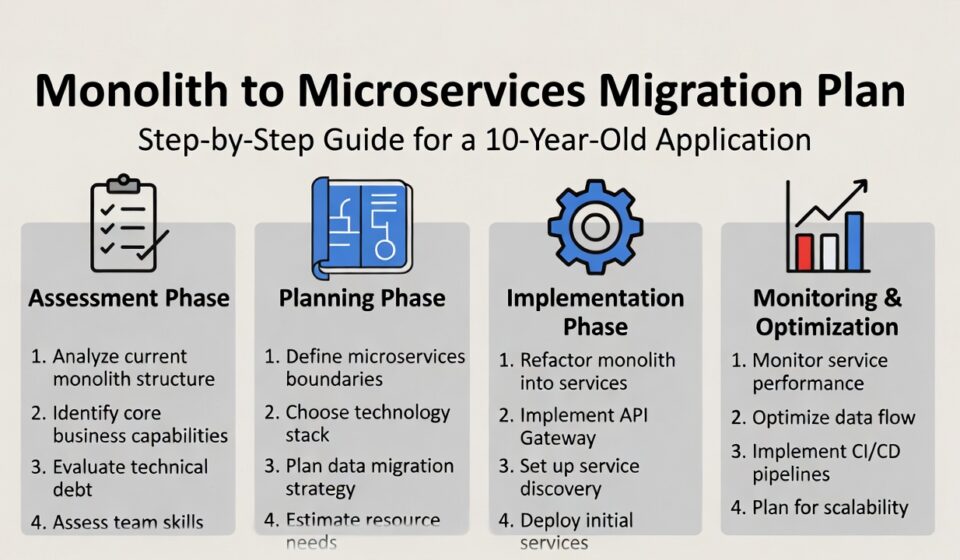
You have a 10-year-old monolith. How would you start the migration into microservices architecture?

Target Architecture
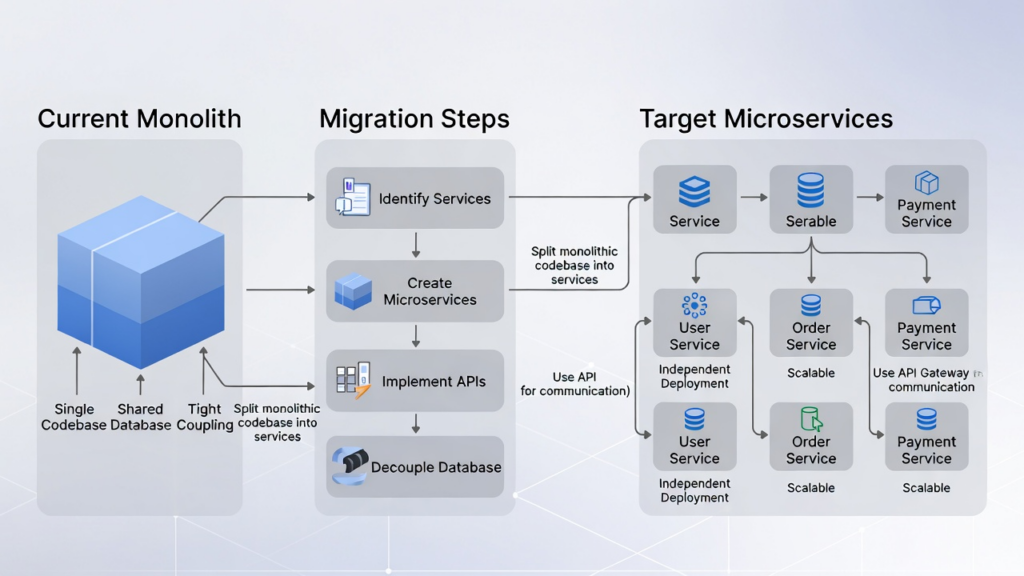
If you’re presenting this to architects or engineering leadership, it’s often easier to show the migration as a sequence of deployment diagrams rather than jumping directly to the target state.
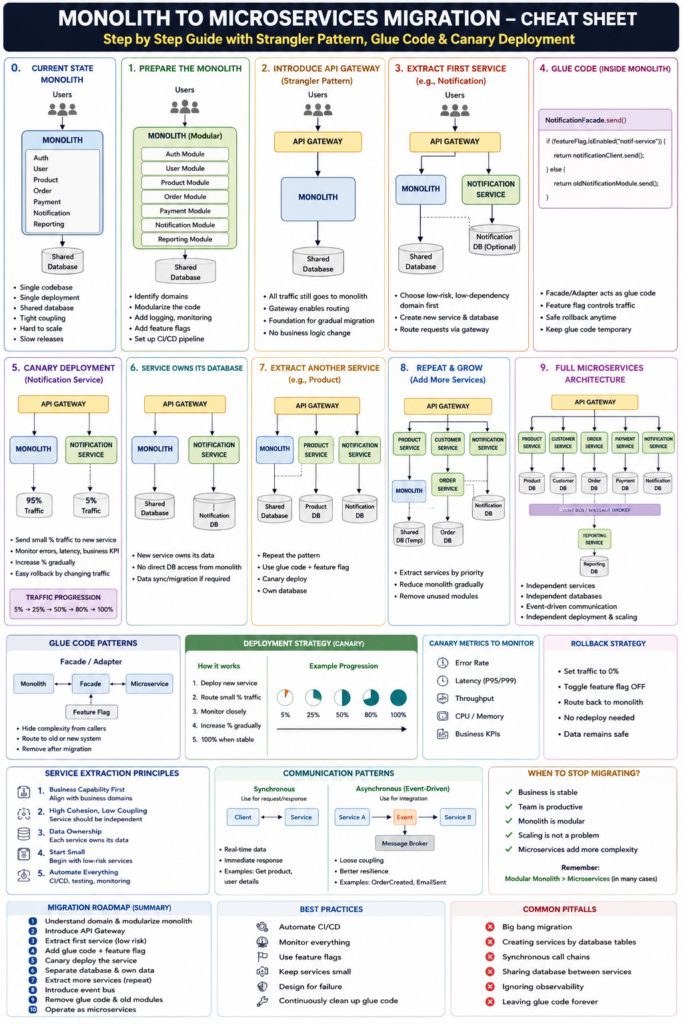
Stage 0 – Current State (Monolith)
Everything deployed together.
                           Users
                             |
                      Load Balancer
                             |
                   +------------------+
                   |     Monolith     |
                   |------------------|
                   | Auth             |
                   | Customer         |
                   | Product          |
                   | Order            |
                   | Payment          |
                   | Notification     |
                   +------------------+
                             |
                      Shared Database
Deployment:
Monolith v1.0
└── Single deployment artifact
Problem:
- Every release deploys everything
- Scaling entire application
- Long regression testing
Stage 1 – Introduce API Gateway
No functionality changes.
                           Users
                             |
                       API Gateway
                             |
                    +----------------+
                    |   Monolith     |
                    +----------------+
                             |
                      Shared Database
Benefits:
- Single entry point
- Routing abstraction
- Foundation for Strangler Pattern
Stage 2 – Extract Notification Service
Notification is usually low risk.
New Deployment
                           Users
                             |
                       API Gateway
                             |
                  +----------+----------+
                  |                     |
            Monolith          Notification Service
                  |
            Shared Database
Glue Code Inside Monolith
Before:
notificationService.sendEmail()After:
notificationFacade.sendEmail()Glue Code:
if(featureFlag.notificationEnabled()){
     notificationClient.sendEmail();
}else{
     oldNotificationService.sendEmail();
}
Canary Deployment
Deploy Notification Service separately.
Traffic:
Email Requests

95% -> Monolith Notification

 5% -> Notification Service
Monitor:
- Error rate
- Latency
- Delivery success
Then:
95/5
80/20
50/50
0/100
Stage 3 – Notification Fully Migrated
                           Users
                             |
                       API Gateway
                             |
                  +----------+----------+
                  |                     |
            Monolith          Notification Service
                  |
            Shared Database
Monolith now calls:
Notification APIinstead of local code.
Stage 4 – Extract Product Service
Next candidate:
- Moderate complexity
- Mostly CRUD
- Clear boundaries
Architecture
                           Users
                             |
                       API Gateway
                             |
         +----------------+------------------+
         |                |                  |
    Monolith      Product Service   Notification
                                          Service
Temporary Database Strategy
Initially:
Product Service
       |
       +-------> Shared Database
Not ideal but practical for migration.
Glue Code
Inside Monolith:
productFacade.getProduct(id)Facade:
if(featureFlag.productServiceEnabled()){
      return productClient.getProduct(id);
}

return monolithProductModule.getProduct(id);
Canary
Product Requests

95% -> Monolith

 5% -> Product Service
Then:
95/5
80/20
50/50
100%
Stage 5 – Product Owns Database
Now move ownership.
                    Product Service
                           |
                     Product DB
Synchronize data:
Monolith Product Module
           |
           v
      Product DB
Temporary synchronization layer.
Stage 6 – Extract Customer Service
Architecture becomes:
                           Users
                             |
                       API Gateway
                             |
   +----------+------------+------------+-------------+
   |          |            |            |             |
Monolith   Product     Customer   Notification
           Service     Service      Service
Glue Code Layer
Inside Monolith:
CustomerFacade
ProductFacade
NotificationFacade
These facades hide migration complexity.
Stage 7 – Event-Based Integration
Current state:
Monolith
    |
Product Service
    |
Customer Service
Many synchronous calls.
Move to events.
                    Event Bus
                         |
      +------------------+-------------------+
      |                  |                   |
 Product Service   Customer Service   Notification
Examples:
CustomerCreated
ProductUpdated
OrderCreated
Stage 8 – Extract Order Service
Now business-critical domain.
Architecture:
                           Users
                             |
                       API Gateway
                             |
   +----------+------------+------------+-------------+
   |          |            |            |             |
Monolith   Product     Customer     Order      Notification
           Service     Service     Service      Service
Canary for Order Service
Never move all orders immediately.
Order Creation

99% -> Monolith

 1% -> Order Service
Then:
99%
95%
80%
50%
20%
0%
Rollback instantly if needed.
Stage 9 – Extract Payment Service
Most risky service.
Architecture:
                           Users
                             |
                       API Gateway
                             |
   +--------+---------+---------+---------+---------+
   |        |         |         |         |         |
Monolith Product Customer Order Payment Notification
         Service Service Service Service Service
Canary:
Payment Requests

99.5% -> Monolith

0.5% -> Payment Service
Increase very slowly.
Stage 10 – Monolith Shrinks
Only remaining modules:
Monolith

├── Legacy Reporting
├── Legacy Admin
└── Remaining Features
Everything else moved.
Final State
                           Users
                             |
                        API Gateway
                             |
  +-----------+------------+------------+------------+
  |           |            |            |            |
Product    Customer      Order       Payment   Notification
Service    Service      Service      Service      Service
  |           |            |            |            |
Product DB Customer DB Order DB Payment DB Notify DB

                             |
                        Event Bus
                             |
                    Reporting Service
Where Glue Code Exists During Migration
Monolith

├── ProductFacade
├── CustomerFacade
├── OrderFacade
├── PaymentFacade
└── NotificationFacade
Each facade:
Feature Flag OFF
      |
      v
Old Monolith Logic

Feature Flag ON
      |
      v
Microservice Call
After migration:
Delete Facade
Delete Old Code
Delete Feature Flag
Recommended Canary Progression
| Service | Initial Canary |
|---|---|
| Notification | 5% |
| Product | 5% |
| Customer | 5% |
| Order | 1% |
| Payment | 0.5% |
Traffic progression:
0.5%
1%
5%
10%
25%
50%
75%
100%
This gives you a true Strangler Pattern migration, where the monolith continuously shrinks, glue code bridges old and new worlds, and every service is introduced through canary deployments rather than a risky big-bang release.